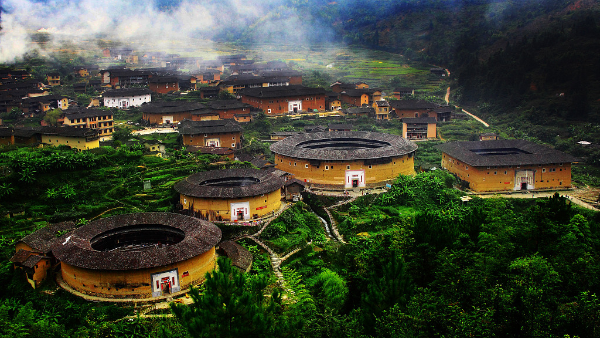
Hakka Architecture
Overview
Hakka architecture represents a unique cultural and historical facet of Chinese building techniques, most notably manifested in the circular or square Hakka enclosure houses scattered across regions such as Jiangxi and Fujian provinces in China. The Hakka people, whose name literally translates to "guest families", originated from North China and migrated to the south, where they adapted local customs and environmental conditions to establish their own distinct language, culture and architecture.
Architectural Characteristics
Hakka round houses, known as "tulou" in Fujian province, are notable for their massive, fortress-like structures made primarily from lime, clay, sand, cobblestones, and fortified with ingredients like brown sugar, egg white and sticky rice. This mixture, after fermenting for 15 days, results in thick and solid walls designed to protect against invaders while providing accommodation. Built on a stone base, these structures are strong and enduring, with walls that incorporate local feng shui traditions to harmonize with the surrounding environment.
Historical and Cultural Significance
The Hakka round houses are not just residential spaces but also serve as a testament to the cultural and historical legacy of the Hakka people. The design of these houses reflects the socio-economic conditions and the defensive needs of their time. As "Oriental Roman Castles", they represent a blend of practicality and cultural symbolism, narrating the Hakka's resilience and adaptability.
Hakka architecture is a profound embodiment of cultural and historical narratives, facing preservation challenges in a rapidly modernizing society. The continued efforts to maintain these structures are vital to safeguarding the heritage and stories of the Hakka people for future generations.
Preservations
In recent years, the preservation of Hakka architecture has become increasingly challenging. Many of these historical structures have decaying facades, and some face the threat of destruction as their original inhabitants move out. Despite concerted efforts by local governments, including financial investments to repair the houses, the shortage of skilled craftsmen poses the most significant hurdle to preservation efforts.
Hakka houses, while losing their appeal as living spaces to modern architectural preferences, remain a crucial link to the cultural identity and historical roots of the Hakka people. They serve as living museums that encapsulate the Hakka spirit of filial piety and community living. Article reference1. Last inheritor of China's traditional Hakka architecture. chinadaily.com.cn. 20182. A legacy that builds on home comforts. chinadaily.com.cn. 2023Photo Gallery(10 pictures)CategoriesLifestyleTagArchitectureHistorical BuildingCultural LandscapeRelatedHakka cultureCatalogue1. Overview2. Architectural Characteristics3. Historical and Cultural Significance4. Preservations- - - []








